Comparing Approaches to Reviewing gym equipment specifications
A structured specification review shows which gym equipment offers meet the same requirements and which depend on exceptions, assumptions, or missing evidence. Use a stable baseline and record decisions before a purchase order is issued.
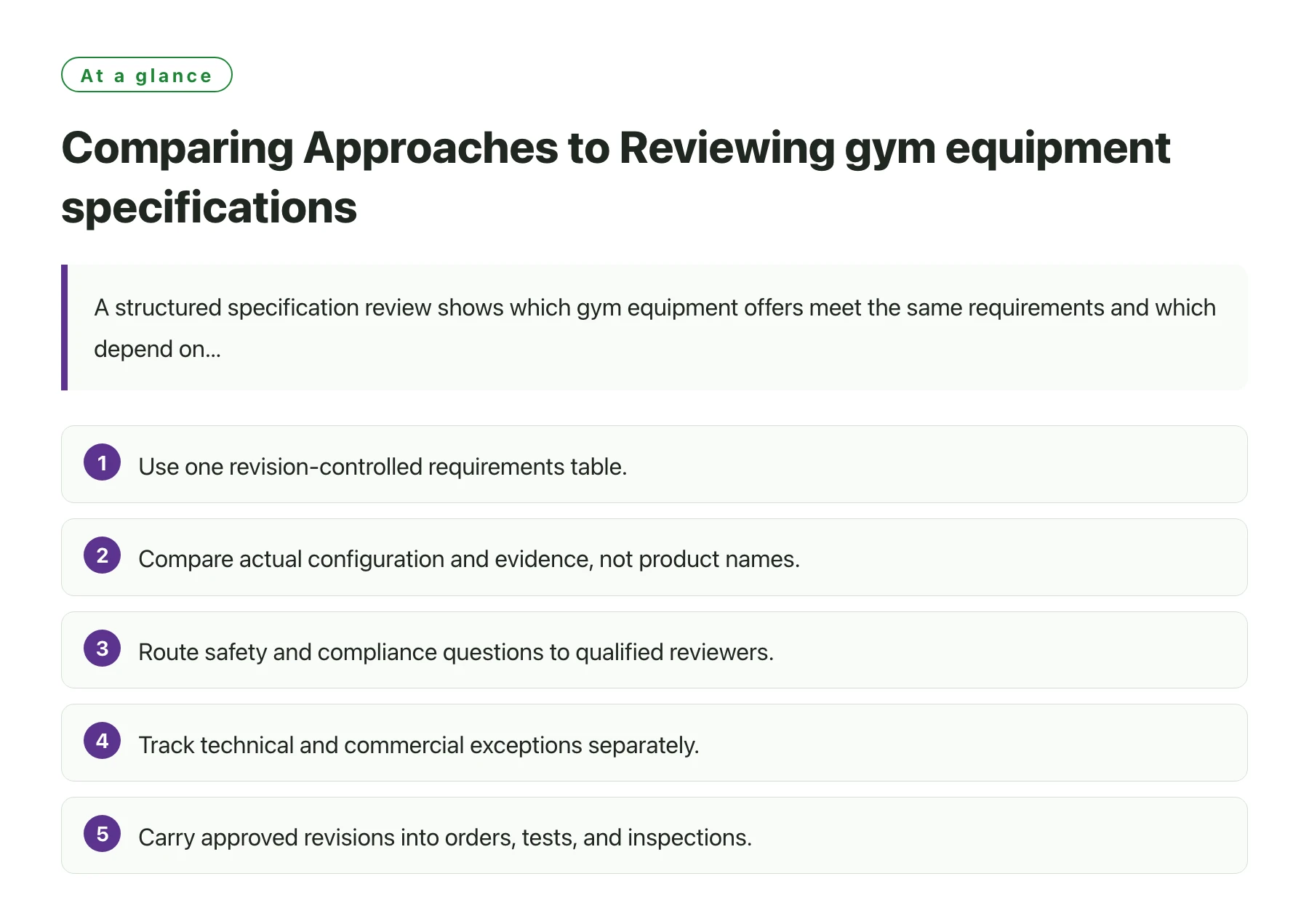
Key takeaways
- Use one revision-controlled requirements table.
- Compare actual configuration and evidence, not product names.
- Route safety and compliance questions to qualified reviewers.
- Track technical and commercial exceptions separately.
- Carry approved revisions into orders, tests, and inspections.
A comparison is only reliable when all bidders answer the same requirement and the buyer can trace evidence and decisions to a specific model.
1. Choose a review method that fits the purchase
A specification review can be a checklist pass, a requirement-by-requirement comparison, or a facilitated technical workshop. A checklist is efficient for a single familiar model; a cross-functional review is better when the product is connected, customized, or used in a commercial facility. Pick the method before quotes arrive so vendors respond to a stable request.
Include procurement, engineering, quality, operations, service, and compliance owners according to product risk. Each group should identify the requirements it can approve and the claims that need specialist evidence. This avoids an attractive commercial offer moving forward while a critical interface or safety question remains unanswered.
2. Create one traceable requirements table
Give each requirement an identifier, description, priority, evidence request, verification method, decision owner, and status. Use measurable values and controlled terminology where possible. Separate mandatory requirements from preferences, and make each statement specific enough that two bidders cannot interpret it in opposite ways.
Add product identity fields such as model, variant, intended user class, resistance type, dimensions, load limits, power supply, firmware, accessories, finish, and packaging. Reference drawings and annexes by revision. A quotation should answer against that baseline rather than an informal email or image.
3. Compare supplier responses consistently
Use columns for requirement, requested value, supplier response, offered configuration, evidence, deviation, cost or schedule effect, and follow-up owner. Ask suppliers to choose “compliant,” “exception,” or “not offered” and to explain each exception. Blank cells should remain open questions, not implied acceptance.
For a multi-model comparison, keep common requirements and model-specific requirements distinct. Normalize equivalent units and clarify how performance was measured. If a supplier proposes a substitute, record its manufacturer, model, function, test evidence, and approval status before treating the offer as comparable.
4. Check safety standards and market fit
ISO 20957-1:2024 specifies general safety requirements and test methods for indoor stationary training equipment, and other parts may add equipment-specific requirements. Determine with a qualified compliance owner which standards, national rules, and test evidence apply to the exact product and market; citing a standard in a brochure is not proof of conformity. [1]
Ask for documents that identify the tested model, configuration, applicable part, test date, laboratory, and any limitations. Check whether supplied accessories, electronics, and intended setting fall within the evidence. Route unresolved safety or regulatory questions to qualified reviewers rather than resolving them through price negotiation.
5. Review performance and durability claims
Translate claims such as smooth motion, quiet operation, accurate feedback, or commercial grade into a testable requirement. Define load, speed, adjustment, operating time, environment, measurement method, tolerance, and sample. Ask the supplier to distinguish tested results from targets or marketing descriptions.
Compare test protocols as well as results. A pass on one setup may not represent a different user weight, adjustment range, duty cycle, or software revision. If evidence is incomplete, decide whether a witnessed test, third-party lab, or revised specification is necessary before purchase.
6. Include service, software, and interfaces
Review user controls, console language, connectivity, electrical compatibility, network needs, data flows, subscription terms, software update process, and service end-of-life. Identify which functions rely on a phone, app, cloud account, or proprietary accessory. Ask what continues to work if a connection or subscription ends.
Specify interfaces to the facility: floor space, ceiling clearance, anchoring, power, access routes, delivery dimensions, and integration with management systems. Confirm who supplies installation, commissioning, and training. A technically capable machine may still be a poor fit if the site cannot support its utilities or service access.
7. Inspect commercial completeness
Compare quoted base model, options, accessories, samples, spare parts, tooling, packaging, labels, test charges, warranty, training, installation, and delivery assumptions. Identify currency, minimum quantities, lead time, payment milestones, validity period, and exclusions. Keep optional enhancements separate from mandatory requirements.
For each exception, ask for its impact on price, functionality, safety evidence, maintenance, and delivery schedule. Do not allow an apparently compliant response to be undercut by an unpriced omission. Use a variance summary that highlights the few differences likely to affect the decision.
8. Use samples and demonstrations with limits
Agree what a sample or demonstration can establish and what remains unverified. Capture model and revision, test conditions, settings, tools, observed result, and open issue. Ensure the demonstration uses the offered configuration, not a specially prepared model with different components.
A sample review is useful for fit, controls, finish, and selected functional observations; it may not establish long-term durability or production consistency. Define additional production checks and acceptance evidence separately. Record any change approved after the sample so the control baseline stays current.
9. Manage exceptions and revision control
Maintain a deviation log with requirement ID, supplier explanation, consequence, supporting evidence, decision owner, and due date. Classify each as accepted, rejected, pending, or conditionally accepted. Require the buyer’s authorized person to sign off on material changes; the technical reviewer should not be assumed to approve commercial terms.
Put a revision and issue date on every specification and comparison. When a requirement changes, identify impacted suppliers and request updated responses. Retain previous revisions and approval records so a later factory, inspection, or service team can see exactly which baseline was purchased.
10. Turn the review into an award decision
Use mandatory gates for non-negotiable requirements and a weighted score for the remaining preferences. Set the weights before evaluating supplier names. Record the reason for selection, major risks, evidence still due, and the owner responsible for closing each item before shipment or installation.
Buyers evaluating Learn more can use one requirements table to align gym equipment offers, test evidence, and supplier follow-up. Confirm that the chosen quote, drawings, approved sample, and purchase order reference the same revision, and assign an explicit owner to any approved exception.
Sources
Frequently asked questions
What is the best format for comparing gym equipment specifications?
Use a traceable matrix with requirement IDs, supplier response, evidence, deviations, impacts, owners, and status.
Should I accept a supplier’s claim that a model meets a standard?
Request model-specific documentation and have a qualified reviewer confirm the applicable standard, market, and configuration.
Can a demonstration replace specification review?
No. A demonstration shows selected behavior under stated conditions, while the specification defines the complete requirement baseline.
How should I handle a supplier exception?
Document the requirement, technical and commercial impact, evidence, decision owner, and written disposition before award.