Fifty Terahash of KAS: How Long 0.01 BTC Really Takes
A 50 TH/s SHA-256 machine needs 445.8 days to produce 0.01 BTC, which is $846.92 at $84,692. Refreshing the dashboard will not move that date. The KAS miner on the next shelf runs on its own clock and is paid in its own coin, and this note is about the first clock — plus the reason the second one cannot be used to skip ahead.

Key takeaways
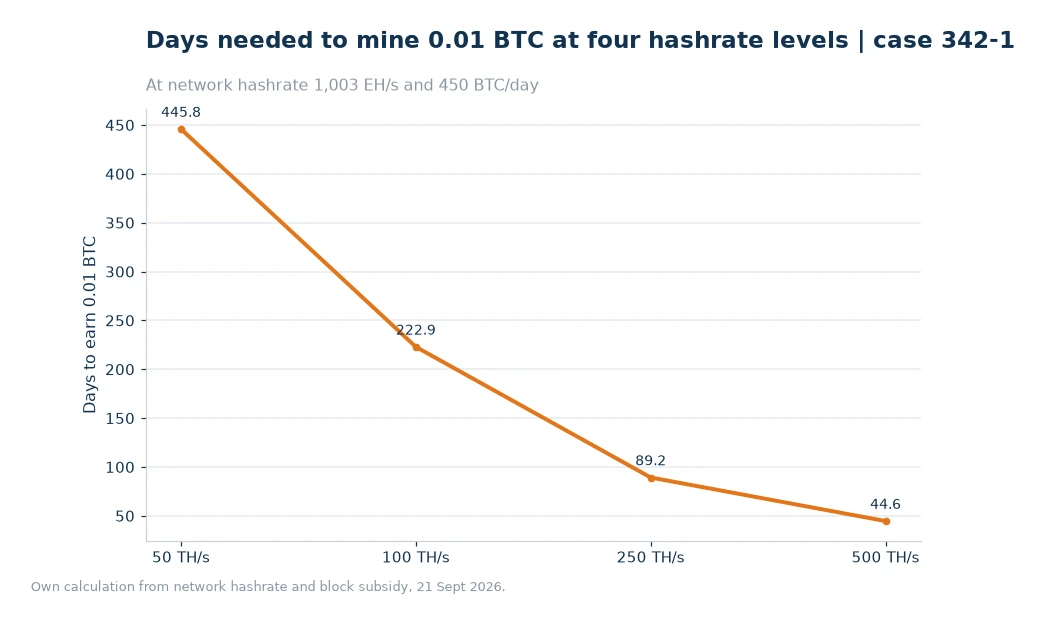
- 50 TH/s yields 0.01 BTC in 445.8 days; 500 TH/s shortens the same goal to 44.6 days.
- 0.01 BTC is $846.92 at $84,692, and about 20,503 KAS at $0.04130647.
- A KAS payout and a Bitcoin payout cannot be added together without a conversion step and a price.
- 445.8 days becomes 464.4 if you gross up for the listed 4% on the PPS-settled block reward.
The target looks modest until it is priced
One hundredth of a coin sounds like a rounding error. Priced at $84,692 it is $846.92, which is a month of hosted capacity, a mid-range graphics card, or a decent fraction of a used ASIC. That mismatch between how the number sounds and what it is worth is the first thing to fix, because every later calculation inherits it.
Expressed in KAS, the same target is stranger still. At $0.04130647 per KAS, $846.92 buys roughly 20,503 KAS. A miner watching a KAS balance climb past twenty thousand units may feel further along than someone watching a balance crawl from 0.0000 to 0.0100. The feeling is an artefact of unit size. The purchasing power is the thing that transfers between the two ledgers.
Unit size also explains a lot of bad budgeting. A pool that pays in a coin worth four cents produces daily numbers in the hundreds or thousands, and those numbers feel like income in a way that 0.00002 BTC never will. Sort the statement by dollar value instead of by coin count and the picture changes immediately: the KAS line and the Bitcoin line are the same size on the day they are sold.
Two machines keep two clocks
A KAS machine hashes a memory-hard algorithm and is paid in KAS by whichever pool it points at. Its output depends on KAS network difficulty, its own hashrate and the pool's settlement rules. Nothing in that sentence mentions Bitcoin, and nothing in Bitcoin's difficulty adjustment cares about KAS. The ViaBTC KAS Mining Pool page is a convenient place to watch the first set of numbers move, provided you do not read them as progress toward a Bitcoin target.
The SHA-256 machine is the opposite case. Its output depends on 1,003 EH/s of Bitcoin network hashrate, 3.125 BTC per block and 144 blocks a day. Those inputs produce the 445.8-day figure at 50 TH/s. Point the same box at a different SHA-256 coin and the arithmetic changes with that coin's issuance, not with Bitcoin's.
Where the two clocks touch is at the wallet. KAS can be sold, and the proceeds can be held as BTC. That is a conversion, not a shortcut: it introduces a price and a timing decision, and it can move the finish date in either direction. Treat the conversion as a second decision with its own risk, not as a way of making the first clock run faster.
A finish date beats a daily rate
Daily income is the number every dashboard shows and the least useful one for planning. At 50 TH/s the daily figure is 0.00002243 BTC, which is small enough to feel abstract. Turn it into a date — 445.8 days from a known start — and the plan becomes something you can compare with a hardware warranty, a lease, or a power contract.
The date also exposes how much of the wait is idle time. A machine that runs 90% of the hours stretches 445.8 days into 495.3, and a machine that runs 80% stretches it into 557.3. Neither failure appears in a daily average that was computed on the assumption of perfect uptime, which is why the assumption is worth writing down next to the date.
There is a third use for the date: it tells you when to review. A target that lands in fourteen months should be re-checked at the next difficulty adjustment and again when the machine's warranty expires, because both events can change the plan without changing the goal. Without a date, there is no trigger for that review and the numbers drift unnoticed.
What the first four months actually bank
The table tracks the same 50 TH/s from a standing start. The share column is the useful one early on: it shows how little of the target is covered in the first weeks, and how the curve only starts to look like progress after the second month.
| Days elapsed | BTC accumulated | Share of target | Value at $84,692 |
|---|---|---|---|
| 30 | 0.0006729 | 6.7% | $56.99 |
| 120 | 0.0026918 | 26.9% | $227.98 |
| 240 | 0.0053836 | 53.8% | $455.95 |
| 445.8 | 0.0100000 | 100% | $846.92 |
Worked example
Everything below follows from one division and one multiplication, so it can be checked on paper in under a minute.
- Daily BTC per TH/s: 450 ÷ 1,003,000,000 = 0.00000044865.
- At 50 TH/s: 50 × 0.00000044865 = 0.00002243 BTC a day.
- Days for 0.01 BTC: 0.01 ÷ 0.00002243 = 445.8.
- In months: 445.8 ÷ 30.44 = 14.6 months, or 1.22 years.
- Dollar value: 0.01 × 84,692 = $846.92.
- KAS equivalent: 846.92 ÷ 0.04130647 = 20,503 KAS.
- Gross-up for the listed 4%: 445.8 ÷ 0.96 = 464.4 days.
- Power at 20 J/TH: 50 × 20 = 1,000 W, so 24 kWh a day and $1.44 at $0.06 per kWh; over 445.8 days that is $641.95, leaving $204.97 of the $846.92.
That last line is the one to sit with. More than three quarters of the target's dollar value is spoken for by electricity at these assumptions, before any hardware cost and before the fee adjustment. A cheaper power contract moves the margin far more than a slightly faster machine does, which is the opposite of what the marketing pages emphasise.
The clock you cannot buy down with a KAS balance
Suppose the KAS machine does well and the KAS balance grows. It still does not shorten the 445.8 days, because those days are a property of SHA-256 hashrate against Bitcoin difficulty. What the KAS balance can do is fund an early purchase of BTC, which changes the mix rather than the mining rate.
That is a legitimate strategy and it needs its own discipline. Pick a conversion rule before the price moves — a threshold, a schedule, or a share of each payout — and write it where you will see it. A rule made in the moment is a prediction dressed as a policy, and predictions about a coin trading under five cents are not something to build a savings plan on.
The ViaBTC multi-currency wallet keeps KAS and BTC in the same account so a conversion is a single internal step, and the ViaBTC App sends hashrate alerts to a phone, which matters more than it sounds when a fan fails at two in the morning.
Frequently asked questions
How long does 0.01 BTC take at 50 TH/s?
445.8 days at a network hashrate of 1,003 EH/s and 450 BTC issued daily, which is 14.6 months; the wait halves to 222.9 days at 100 TH/s and drops to 44.6 days at 500 TH/s.
Can KAS payouts shorten the wait for 0.01 BTC?
Only through conversion. KAS rewards do not change Bitcoin difficulty or the hashrate of a SHA-256 machine, so selling KAS for BTC changes the funding mix rather than the mining rate.
What does the KAS price have to do with a Bitcoin target?
It sets how much KAS equals the target: at $0.04130647, 0.01 BTC worth $846.92 is about 20,503 KAS, so a higher KAS price means fewer coins need to be sold to reach the same amount.
Put the date on the calendar
Choose the hashrate, divide the target by its daily output, and write the finish date somewhere you will see it in a bad week. Then check the two assumptions that can move it: uptime and the listed fee on the block-reward slice. If the date still looks acceptable after both are applied, the plan is honest. If it only works at 100% uptime and zero fees, it was never a plan.
Sources: the ViaBTC pool and fee pages for KAS settlement and the listed 4%[1]. Chain inputs read 21 Sept 2026: network hashrate 1,003 EH/s, difficulty 132.76 T, subsidy 3.125 BTC per block, 144 blocks a day, BTC $84,692, KAS $0.04130647. Published 24 Oct 2026. Day counts assume continuous uptime and 20 J/TH at $0.06 per kWh.