Standard RTA Kitchen Cabinet Sizes and Fillers
Wall cabinets come in widths from 9 to 39 inches and three heights, 30, 36 and 42 inches, and the price does not track the width evenly. A 9-inch-wide 30-inch-high cabinet costs $179.54, which is $19.95 per inch, while a 21-inch-wide cabinet at the same price works out at $8.55 per inch. The size ladder explains both the bargain and the filler.
Key takeaways
- Wall cabinets are 12 inches deep, 30, 36 or 42 inches high, and 9 to 39 inches wide.
- Every single-door 30-inch-high wall cabinet from 9 to 21 inches is $179.54, so the 21-inch is the best value in that group.
- Double-door 30-inch-high wall cabinets from 24 to 39 inches are all $347.76.
- A 96-inch wall run closes exactly with four 24-inch cabinets; three 30-inch cabinets leave 6 inches for a filler.
The width ladder, 9 to 39 inches
The width list is the first thing to copy onto a planning sheet. Wall cabinets run from 9 to 39 inches, and the door count changes at 24 inches: 9, 12, 15, 18 and 21-inch cabinets carry a single door, while 24 inches and above carry two. That one detail explains most of the price behavior on the page.
Below 24 inches, the cabinet is a single door on a narrow box, and the hardware count is identical whether the box is 9 inches or 21. CasaBuilt prices every 30-inch-high single-door wall cabinet at $179.54, so the 21-inch version delivers 12 more inches of storage for the same money as the 9-inch. A wall that can take a 21-inch cabinet should rarely take a 9-inch one, unless the 9-inch is closing a run beside a window.
Above 24 inches, the double-door front arrives and the price jumps to $347.76 for every width up to 39 inches. That is the same pattern one step up: the 39-inch double-door cabinet holds 15 more inches of storage than the 24-inch for the same price. The ladder rewards width, which is why the per-inch chart slopes the way it does.
Heights and the price step
Height is the second choice and it moves the price less than width does. Single-door wall cabinets are $179.54 at 30 inches high, $197.06 at 36 inches and $222.57 at 42 inches. Double-door cabinets are $347.76, $374.81 and $437.41 over the same three heights.
The steps are worth reading as percentages. From 30 to 36 inches, a single-door cabinet adds $197.06 − $179.54 = $17.52 for 6 inches of height, which is 9.8% more money for 20% more height. From 36 to 42 inches, it adds $222.57 − $197.06 = $25.51, or 12.9% more, for another 6 inches. A taller cabinet is a cheap way to add storage if the ceiling allows it.
Double doors widen the same step. $347.76 to $374.81 is $27.05, and $374.81 to $437.41 is $62.60. The last jump is the largest in the range, which is why a 42-inch double-door wall cabinet is usually chosen for the look of a full-height run rather than for the storage alone.
| Size | Doors | Sale price | Price per inch |
|---|---|---|---|
| 9 x 30 in | Single | $179.54 | $19.95 |
| 21 x 30 in | Single | $179.54 | $8.55 |
| 24 x 30 in | Double | $347.76 | $14.49 |
| 30 x 30 in | Double | $347.76 | $11.59 |
| 39 x 30 in | Double | $347.76 | $8.92 |
Where fillers become unavoidable
A filler is a strip that takes up the inches a standard cabinet cannot. It appears for three reasons: a run that is not a multiple of 3, a corner where two runs meet and a wall that is out of square. The first is arithmetic, the second is geometry, and the third is the reason every measurement guide tells you to check more than one point along the wall.
Take the arithmetic first. Widths step in 3-inch increments, so a 96-inch run closes exactly with four 24-inch cabinets: 4 × 24 = 96. It also closes with 39 + 39 + 18 = 96. Three 30-inch cabinets reach 90 inches and leave 6 inches, which is a filler or a wider cabinet. Two 39-inch cabinets reach 78 and leave 18, which is another cabinet rather than a filler.
Corners are the second source. Two runs meeting at 90 degrees cannot both keep a full-width cabinet at the joint, so one side gives up its front and the other takes the corner. Plan the corner first and fill outward, because the last 3 inches at the far end of a run are easy to absorb and the last 3 inches at a corner are not.
Height and depth add a third constraint. Wall cabinets are 12 inches deep and 30, 36 or 42 inches high, so a run under a window with a low sill may only take the 30-inch height. Measure the sill height and the ceiling before choosing, and use the measurement guide for the wall readings, because the difference between a 30 and a 42-inch cabinet is a decision you cannot undo after the order.
Per-inch math before you commit
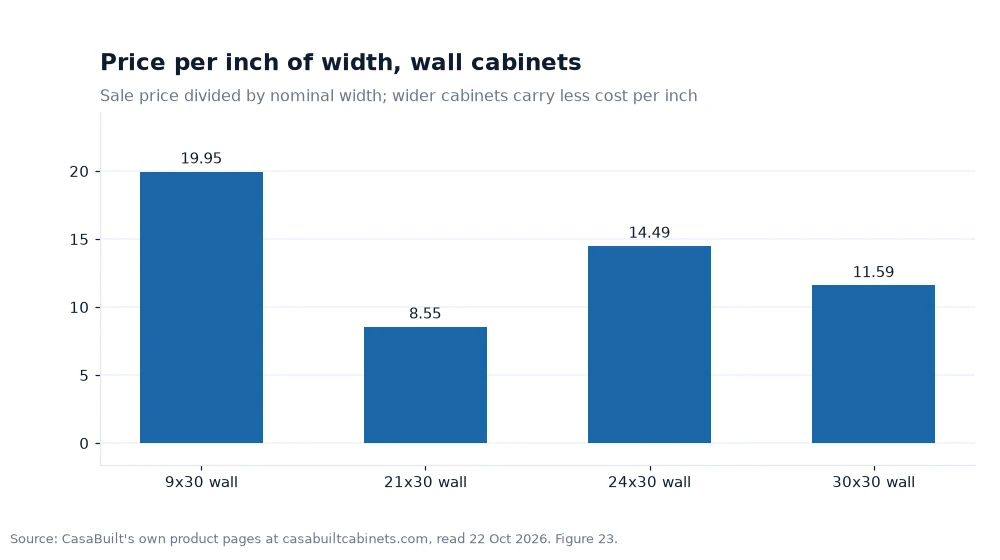
The chart turns the ladder into a single view. The 9-inch cabinet is the worst rate at $19.95 per inch, because the front hardware is spread over the smallest width. The 21-inch is the best at $8.55, because it carries the same $179.54 price over 12 more inches. The 24-inch resets to $14.49 when the second door arrives, the 30-inch falls to $11.59, and the 39-inch reaches $8.92.
Read the resets as price steps rather than as quality signals. The step at 24 inches is a door and a hinge; the step at 36 inches in height is a taller panel. Buyers comparing rta kitchen cabinets by eye tend to see three similar white boxes, while the price list sees three different hardware counts.
The practical rule: fill a run with the widest cabinets the space allows, then close the remainder with the widest cabinet that fits the gap. A 21-inch cabinet is often the best closing piece in the range, because it costs the same as a 9-inch and gives 12 more inches of storage.
Worked example: the same 60 inches, two ways
The chart reports four rates for 30-inch-high wall cabinets: $19.95 at 9 inches, $8.55 at 21 inches, $14.49 at 24 inches and $11.59 at 30 inches. Rebuild each from the published prices. $179.54 ÷ 9 = $19.9489, rounded to $19.95. $179.54 ÷ 21 = $8.5495, rounded to $8.55. $347.76 ÷ 24 = $14.49 exactly. $347.76 ÷ 30 = $11.592, rounded to $11.59.
Now fill a 60-inch run with single doors: 21 + 21 + 18 = 60, and all three sit in the 9 to 21-inch price band, so the cost is 3 × $179.54 = $538.62. That is $538.62 ÷ 60 = $8.98 per inch across the run.
The same 60 inches in double doors is 24 + 36 = 60, at 2 × $347.76 = $695.52, or $11.59 per inch. The difference is $695.52 − $538.62 = $156.90 for the same wall length, and it buys four doors on two cabinets instead of three doors on three cabinets. Neither answer is wrong; the point is that the per-inch figure changes with the door count, not with the inches alone.
Frequently asked questions
Why does a 21-inch wall cabinet cost the same as a 9-inch?
Because both are single-door cabinets in the same 9 to 21-inch band, and the published price for a 30-inch-high single-door wall cabinet is $179.54 across that band. The door, hinge and box assembly are the same; only the panel widths change.
How wide should a filler be?
As narrow as the gap allows, and never wider than it needs to be. Fillers exist to absorb the difference between a run and the nearest standard width, so a 6-inch gap takes a 6-inch filler rather than a 12-inch cabinet forced into place. Check the gap at the top and bottom of the wall before cutting anything.
Do I need a filler at a corner?
Usually something has to give at a corner, either a filler, a blind cabinet or a corner cabinet. Corner bases are published at $528.87 for 33 to 36 inches and blind bases at $412.62 for 33 to 39 inches, which is the price of solving the geometry rather than hiding it.
Close the run on paper first
Write the wall length, subtract the fixed objects, and fill the gap with widths from the ladder, widest first. Note where the remainder lands and whether a filler can absorb it. Check the sill and ceiling heights before committing to a 42-inch cabinet, and price the run with the door count you actually want, not just the width. The arithmetic takes ten minutes and prevents the one order nobody wants: the right cabinets in the wrong sizes.
Figures quoted here come from the manufacturer's own website, read 22 Oct 2026[1].