What Has Changed in Custom Fragrance Development Since 2020
The mechanics of making a perfume have not changed much; the rules and expectations around it have. Since 2020 the pressure has come from four directions at once: tighter fragrance safety standards, briefs that move faster because they are shaped by social platforms, packaging rules that now reach into material choice, and supply chains that made brands care where the bottle and the pump actually come from.
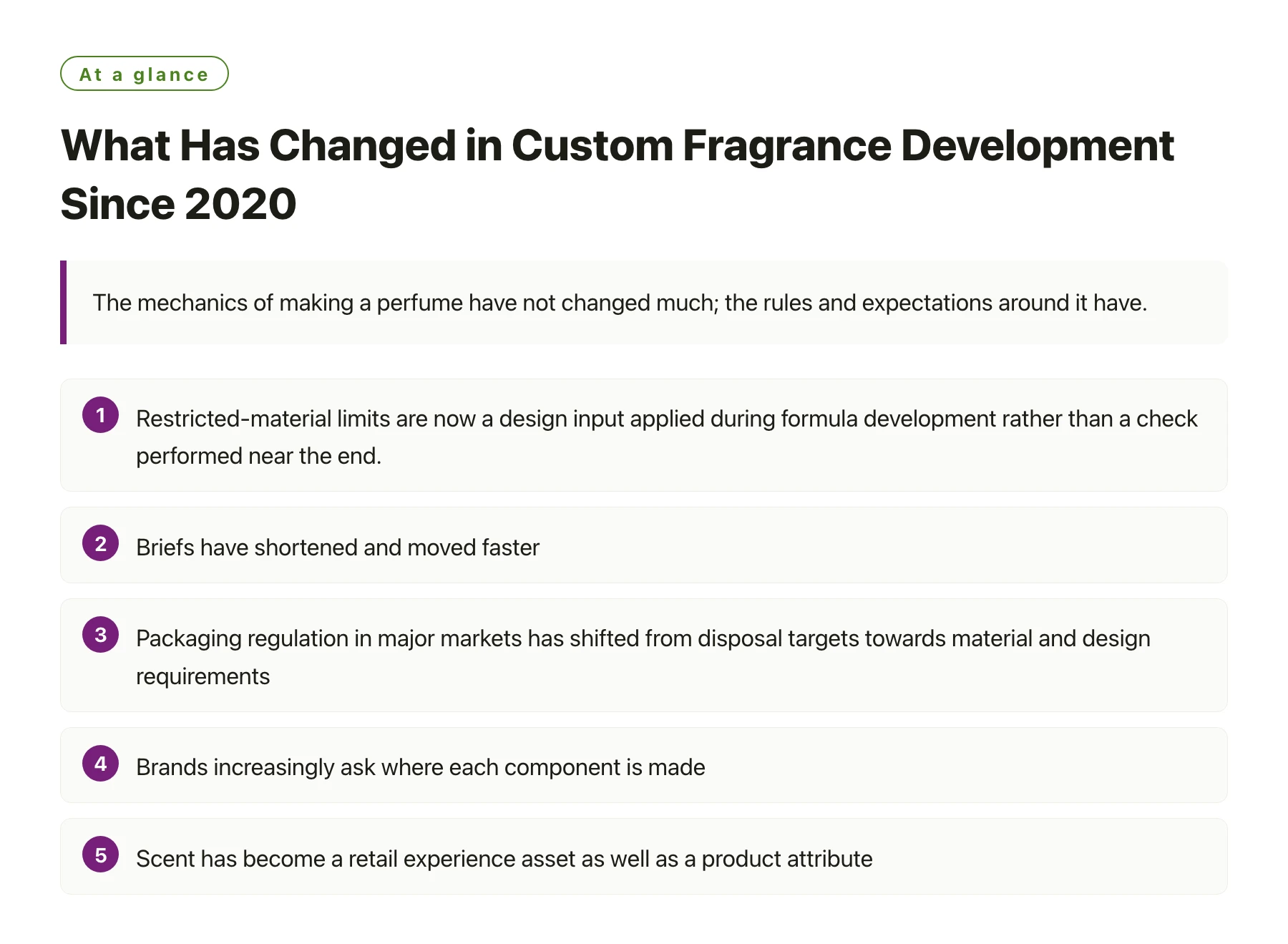
Key takeaways
- Restricted-material limits are now a design input applied during formula development rather than a check performed near the end.
- Briefs have shortened and moved faster, which raises the value of a supplier that can answer feasibility questions quickly.
- Packaging regulation in major markets has shifted from disposal targets towards material and design requirements, which affects pack choice earlier in the project.
- Brands increasingly ask where each component is made, not just where the product is filled, because lead time risk sits with components.
- Scent has become a retail experience asset as well as a product attribute, which changes what a brand asks a manufacturer to help with.
Six years is a short time in perfumery and a long time in compliance and retail. The changes below are the ones that show up repeatedly in development conversations, and each has a practical consequence for a brand planning a launch in the next twelve months.
The aim is not to catalogue everything that has moved, but to identify what a product team should do differently now compared with a project run in 2019.
Regulation moved from a checkbox to a design input
The most significant structural change is sequencing. Ten years ago a brand could settle a formula and then ask about restrictions. Today the sensible order is reversed: the target markets are named at brief stage, the applicable limits are applied while the formula is still adjustable, and the documentation is assembled as the project progresses.
The IFRA Standards, which set maximum use levels for fragrance materials in finished products, are revised on an ongoing cycle [1]. For a brand this has a specific consequence: a formula that was compliant when it was created may need review as the standards move, and a reformulation is far cheaper before a pack and an artwork have been signed off.
More topics, more label content
Cosmetics frameworks have grown more specific over the same period. The European Commission maintains a set of specific topics covering areas such as ingredient labelling, nanomaterials and claims [2], and each of those touches fragrance products somewhere - in the ingredient list, in the allergen declaration, or in what the front of the pack is allowed to say. The practical effect is that label copy needs a compliance review earlier than most brand teams expect.
Documentation as a launch dependency
Where documentation was once a folder assembled after production, it is now often the gate that decides whether goods can be shipped. Brands that treat the document list as part of the critical path schedule fewer late surprises, because the pieces they do not control - third-party testing, certificates, translations - have their own lead times. It also helps to know what a manufacturer says about itself in this area: a company profile such as about Xuelei normally states which standards the site works to and what it publishes for customers, which is a quick way to see whether documentation is treated as routine.
Then and now, in six areas
| Area | Around 2020 | Now |
|---|---|---|
| Restricted materials | Checked after the formula was chosen | Applied during formula development, then re-checked as standards move |
| Brief cycle | A document circulated and revised over weeks | A shorter brief, often revised live during a call |
| Packaging | Selected on cost and appearance | Selected on cost, appearance and material requirements that vary by market |
| Sourcing questions | Where is the product filled? | Where is each component made, and what is the second source? |
| Retail expectation | Scent as a product attribute | Scent as an experience, including in physical retail and brand spaces |
| Documentation | Assembled before shipping | Tracked from brief stage as a launch dependency |
The pattern across all six rows is the same: decisions that used to be made late are now made early, because they constrain choices that are expensive to revisit. Reading Xuelei official site with these six rows in mind is a quick way to judge how far a supplier has adapted.
If you are rebuilding an existing formula that has been in market for years, treat it as a new project for compliance purposes rather than a reorder. The scent can stay identical while the documentation, the label and the pack requirements have all moved underneath it.
Packaging rules reached the material list
Packaging used to be a design and logistics decision. It is now a regulatory one in the largest markets, because rules increasingly address how much material a pack uses, what it is made from, and how it is collected. In the EU, the Packaging and Packaging Waste Regulation addresses design and material requirements rather than only end-of-life targets [3].
For a fragrance brand this shows up as a set of questions that did not exist a few years ago: how much void space is inside the box, whether the insert can be eliminated, what proportion of recycled content the carton carries, and whether a refill or a lighter pack is viable for the price point.
The reason this belongs in a development article rather than a sustainability one is timing. Weight and material decisions are made when the pack is chosen, which is now early in the project because compatibility testing depends on it. Getting the pack right the first time is cheaper than re-testing a formula in a new container.
What this means for a brand planning a launch now
Three habits separate projects that run smoothly from projects that do not. Name the destination markets at brief stage. Choose the pack before the formula is frozen. And ask a supplier to describe its own scope in writing, including which stages happen on site and which are subcontracted.
That last point has become more important, because lead time risk now sits with components rather than with compounding. A factory that can see its own supply chain clearly will tell you which parts are exposed, and it is worth asking a prospective partner how it handles a single-source component.
It is also worth looking at how a manufacturer positions itself. For brands working at the top of the market, orientation towards a manufacturer for luxury fragrance brands usually means more work on finish quality, decoration and packaging tolerance, which changes the schedule as well as the price.
One further shift is worth noting because it affects briefs rather than factories. Scent is increasingly used as a brand experience rather than only as a product: retail spaces, hotel environments and events. A manufacturer that also runs a museum of scent, as Xuelei does in Guangzhou alongside its production business, sees that demand from the other side, which makes it a reasonable party to ask about experience formats as well as product formats.
None of this makes fragrance development harder in principle. It makes late decisions more expensive, which is a different problem and a more manageable one - provided the brief arrives with the market, the pack and the timeline already attached to it.
Sources
- IFRA Standards Library (International Fragrance Association) —— The IFRA Standards Library lists the restrictions the fragrance industry applies to individual fragrance ingredients, based on safety assessments; it is the reference point for compliant fragrance formulation.
- European Commission: Cosmetic Products — Specific Topics —— EU pages covering specific cosmetics topics such as product claims, nanomaterials and animal-testing rules.
- European Commission: Packaging Waste and the PPWR —— EU rules on packaging and packaging waste, including the Packaging and Packaging Waste Regulation requirements on recyclability and design.
Frequently asked questions
Has fragrance regulation actually become stricter?
In practice, what has changed most is the volume of specific requirements and the frequency of updates rather than a single tightening. Materials move on and off restriction lists on a rolling basis, which is why formula review is now routine rather than exceptional.
Do packaging rules apply to a small fragrance brand?
If you sell into a market with packaging requirements, they apply to the pack regardless of brand size. The practical effect is usually on material choice, box volume and how much recycled content the carton carries.
Why have development timelines not shortened even though communication is faster?
Because the fixed blocks - stability testing, component lead times, print and artwork approval - have not compressed. Faster communication removes waiting between decisions, not the duration of the tests themselves.
Should we still choose a manufacturer based mainly on price?
Price remains a necessary filter, but the differentiator now is usually how early a supplier raises compliance and component questions. Those conversations determine whether the quoted price survives to bulk.
What single change would you make to a 2019 brief?
Add the destination markets and the chosen pack to the first page. Both used to be resolved later, and both now constrain the formula, the testing scope and the documentation list.