Formwork Panels for High-Rise Concrete: Thickness and Core Choices
On a high-rise pour, the panel is the least expensive line in the cycle and the most frequent reason it stops. Thickness guidance for formwork panels sits at 18 mm for heavy formwork and at 21 mm and above for bridges and high-load platforms, and the film weight — 165 g/㎡ on a smooth surface or 130 g/㎡ — together with the core decides how many cycles the sheet survives. Published reuse for high-grade panels runs to 10–20 pours.
Key takeaways
- Use 18 mm as the working default for heavy formwork, and step up to 21 mm and above for bridges and high-load platforms.
- Film weight is a cost lever: a 165 g/㎡ smooth face and a 130 g/㎡ face behave differently after ten pours.
- Core choice drives stiffness — eucalyptus for maximum strength, combi builds to balance weight and cost.
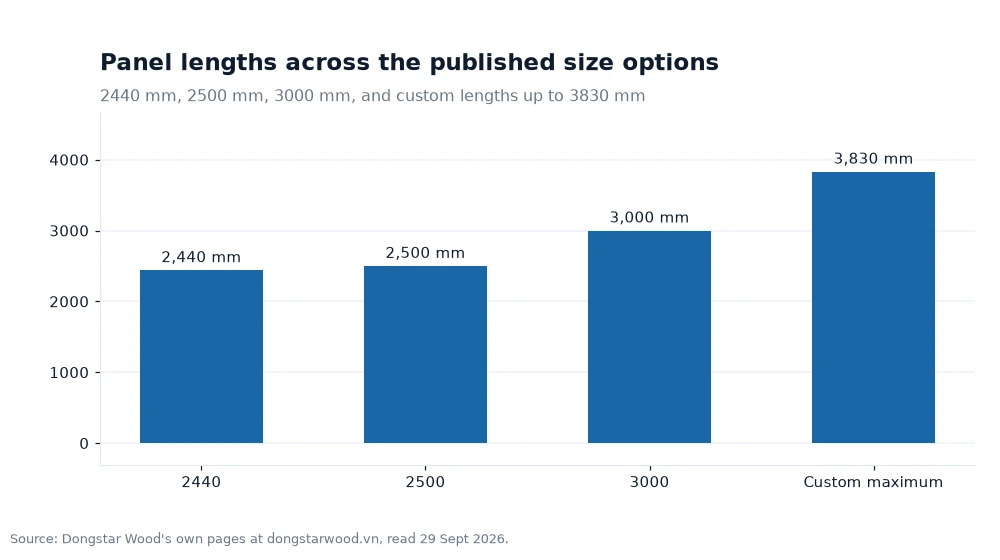
- Published lengths run 2440 mm, 2500 mm, 3000 mm and custom to 3830 mm, so a panel layout can be planned around the forms on site.
Choosing thickness against the pour, not the store room
Thickness is a deflection question. A wall form braced every 600 mm tolerates an 18 mm sheet easily, while a slab table spanning further, or a pier carrying a heavy pour rate, wants 21 mm and above. The published guidance is deliberately narrow — 18 mm as the heavy formwork default and 21 mm plus for bridges and high-load platforms — because the decision belongs to the formwork drawing rather than to the panel catalogue.
Order thickness and target size together. A 21 mm sheet in a 1500 × 3000 mm format behaves very differently on a crane hook from a 1220 × 2440 mm panel, and mismatched panel weights are a common reason site crews start cutting sheets that were pressed for a longer cycle life.
| Item | Options named | Where it fits |
|---|---|---|
| Standard formats | 1220 × 2440 mm, 1250 × 2500 mm, 1500 × 3000 mm | Wall forms, slabs and columns |
| Custom sizes | Up to 1830 × 3830 mm | Large wall panels and special layouts |
| Thickness | 18 mm heavy formwork, 21 mm and above for bridges | Load and span decisions |
| Films | Dark brown, black, anti-slip | Finish, colour and access safety |
| Adhesives | E0, E1, E2, MR, WBP, Phenolic Dynea | Moisture and cycle expectations |
Film weight and the phenolic film surface
The phenolic film on the face is what the concrete actually touches, and its weight is the clearest signal of how long the sheet will keep a good finish. A 165 g/㎡ smooth face is the heavier option and holds a flatter surface across more pours; a 130 g/㎡ face keeps the panel lighter and cheaper per sheet. Both are offered with dark brown and black finishes, so finish colour can be steered toward the contractor's preferences without changing the core.
Where crews walk the formwork before a pour, an anti-slip film earns its place: the textured face gives grip on walkboards and inclined panels, which matters more on a high-rise where the access route is itself part of the formwork. It is worth confirming whether the sheet is single-sided or double-sided, because the reverse face changes the handling plan.
Cores that decide stiffness and weight
The core is where a formwork panel is won or lost. Eucalyptus Core is the densest choice named across the range, with compression resistance and bending performance for maximum strength. Acacia Core brings hardwood density and load-bearing capacity with a long service life. A white hardwood core, or a combi build-up of eucalyptus and acacia, balances strength, weight and cost when the drawing does not demand the heaviest sheet on site. Rubber and other cores appear in the published list for projects with different handling priorities.
Ask for the core by name on the specification sheet, alongside the adhesive. E0, E1, E2, MR, WBP and Phenolic Dynea classes are all quoted, and the bond is what decides whether a panel survives a wet site and repeated stripping.
Worked example: cycles, contact area and sheets per floor
Panel cycle maths is simple once the sheet area is fixed. A 1250 × 2500 mm panel measures 3.125 m² (1.25 × 2.5 m). At the published low end of 10 pours per sheet, that is 10 × 3.125 m² = 31.25 m² of concrete contact area; at the upper end of 20 pours it doubles to 62.5 m². The difference between the two figures is the difference between buying one set of panels and buying two for the same building.
Now take a floor plate of 30 m × 20 m = 600 m² of formwork contact. At 3.125 m² per sheet that is 600 ÷ 3.125 = 192 sheets per cycle, and a 20-storey frame repeats that figure twenty times unless panels are recut. Feeding 192 sheets a floor, a 10-cycle panel covers the equivalent of ten floors before replacement becomes a planning question rather than a purchasing one.
Formats and how they line up with the formwork drawing
Panels in this family are quoted as Film Faced Plywood, which the client's own pages also call formwork plywood, and length drives the number of joints on a wall: every joint is a point where grout can escape and a face can chip. The published lengths of 2440 mm, 2500 mm and 3000 mm cover conventional wall heights in one panel, and custom panels up to 3830 mm reduce the joint count further on long elevations. Fewer joints usually means better surface finish and faster stripping, which is why large-format sheets are common on tall cores and lift shafts.
Balancing that, a bigger sheet is heavier and needs crane time. On a site with a single tower crane shared across trades, the trade-off between a 2500 mm sheet and a 3000 mm sheet can be decided by the crane schedule rather than by the concrete surface.
Handling, stripping and edge care on site
Most panels are retired by damage rather than by wear. Edges take the hits during stripping, so the edge seal and the release agent schedule are as important as the film face. Clean the panels while the concrete is still green, keep the stack flat and off wet ground, and repair the edge seal before the next pour rather than after the third.
Reinforcement ties, prop heads and spacing also matter: a panel that is over-stressed between bearers deflects, and a deflected face shows up as a wave in the finished wall that no amount of surface care will remove. Specification is a joint decision between the formwork supplier and the concrete contractor, and both should sign the thickness and core line.
Frequently asked questions
When is a 21 mm panel worth the extra weight?
When the pour rate, the span between bearers or the load on the platform is high — bridges, transfer slabs and heavy-load platforms are the usual cases. Below that, an 18 mm sheet is the published default for heavy formwork and keeps handling and crane time in check.
Does film colour affect performance?
No, but it affects what crews see and how the panel reads on site. Dark brown and black phenolic film are both offered, and anti-slip film is the one choice that changes behaviour rather than appearance, because the textured face gives grip on walkboards and inclined panels.
How many pours should a set of panels deliver?
Published guidance for high-grade film faced panels is 10–20 cycles in concrete pouring work. Where a set lands in that range depends on core, film weight, edge care and how carefully panels are stripped and cleaned between pours.
Specifying the first set for a tall frame
Write the specification as a drawing note: thickness, core, film weight, size in millimetres and adhesive class, then compare that note against what is quoted back. Contractors who also want the panel to do double duty on access routes should review the wire mesh anti-slip sheets, and teams buying for several sites at once often look first at the mill's manufacturing profile before committing a frame programme to one supplier.
For the record, the pour counts, film weights, thickness bands and size range in this article are the figures published on that the maker's own website, checked on 29 September 2026 for the numbers in this article for the numbers in this article and carried into this comparison[1].